Stage seven of seven
Wedding Day
Umshado
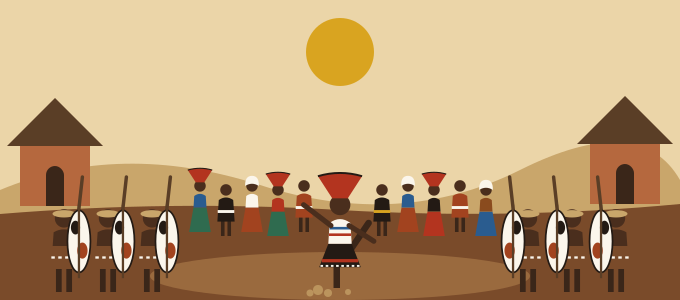
A wedding day is set and the bride's party arrives in procession. On the dance ground (isigcawu) the chief's policeman asks the bride whether she loves the groom. She answers by starting a song and dancing (ukusina), then gives the policeman a mat as a sign of her agreement. Later that same day she gives umabo, her gifts to the groom's family.
Kukhishwa usuku lomshado, umakoti nozakwabo bahamba nomkhosi, kwenziwa imicimbi yesiko, kuhlanganisa ukucula, ukudansa, nokuvuma umthetho womshado.
What happens
A day is set with the bride's family: on that day the young woman, for whom lobola has been paid, will be brought to complete the good kinship being built.
Kukhishwa usuku kubo kamakoti ukuthi ngosuku oluthile sizonilethela intombi eseniyilobolile naqeda ukuzofeza noma ukuzoqedela ubuhlobo obuhle obakhiwayo.
Once it is agreed, the umthimba (the bride's party) sets out from her home before dawn, together with the bride.
Kuvunyelwane bese kubo kamakoti kuphume umthimba okungabantu abahamba ezintathakusa kanye nomakoti.
The umthimba arrives while the groom's family is still asleep and comes in with the bride, and a cry goes up: "Where is the child?"
Umthimba ufika kusalelwe kubo kamkhwenyana, bangene nomakoti kukhuzwe umntwana kuthiwa "uphi umntwana".
The people of the umthimba run, striking the houses.
Abantu bomthimba bagijima beshaya izindlu.
The custom of the place is carried out. They are then shown a tree outside the homestead, where they spend the day with the bride until she is dressed.
Kwenziwa usiko lwakhona, bese bephuma bekhonjiswa isihlahla ngaphandle komuzi, lapho bezohlalakhona usuku lonke nomakoti aze avunule.
The bride goes to the dance ground (isigcawu) chosen by the groom's family, where she will dance.
Umakoti uya esigcawini esikhonjwe abakwamkhwenyana, lapho ezosina khona.
The amabutho of the area arrive and cross the dance ground carrying shields and calling out war cries.
Kufike amabutho endawo azodabula isigcawu ephethe amahawu ekhuza izaga.
The chief's policeman asks three times: "Bride (he calls her by name), the law asks: do you love the groom (he calls him by name and surname)?"
Iphoyisa lenkosi libuza ukuthi "Makoti (amubize ngegama lakhe) uyabuza umthetho x3, uyamuthanda na umkhwenyana (amubize ngegama nesibongo)?"
The bride answers by starting a song, and sings and dances until she reaches the policeman and gives him a mat, a sign that she agrees she loves the groom.
Umakoti eqamba icule acule asine aze afike ephoyiseni alinike icansi, eliphethe okukhombisa ukuvuma ukuthi uyamthanda.
Before anyone goes to the dance ground, a cow is slaughtered early in the morning at the groom's home.
Ngaphambi kokuthi kuze kuyiwe esigcawini, ekuseni kuhlatshwe inkomo kubo kamkhwenyana.
The bride goes into the cattle kraal to pierce the cow's stomach, and other customs are carried out as well.
Umakoti uyangena esibayeni azobhobosa isisu senkomo, kwenziwe nolunye usiko kanjalo kanjalo.
When they return from the dance ground, the bride gives umabo: gifts of blankets, mats, pinafores and everything she gives to her new family.
Uma sekubuyiwe esigcawini, umakoti uyaba (umabo), aphe izipho okuyizingubo, amacansi, amaphinifa, nayo yonke into enikazi abantu basemzini.
This is done in the cattle kraal, and after it the wedding is complete: there is eating, and drinking for those who drink, until the day ends.
Lokhu kwenzelwa esibayeni, bese emuva kwalokho umshado usuphelele, sekuyadliwa bayaphuza abaphuzayo kuze kuphele usuku.